
An upcountry hotel goes digital, part 6: looking back — reducing OTA reliance was a chain of small decisions
Putting both phases together: build an entry point so the direct channel can run, let data decide whether to automate, then use a checkout card to bring guests back. No large hotel system was built — just a chain of small steps decided by real data.
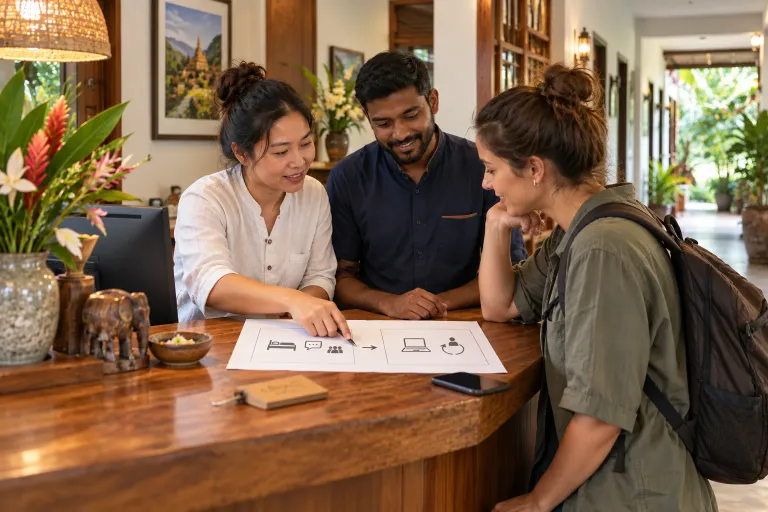
This series follows an upcountry Thai hotel, step by step, into digital. The story comes from our real implementation experience in hospitality — if you run a small accommodation in the provinces, you should see your own front desk in every chapter. Each chapter explains: what was built, what was deliberately not built, and what evidence earned the right to move on.
After two phases, what the hotel had become
Put both phases together and the change at this provincial hotel is clear:
- The direct channel went from “can’t say” to “visible.” Every phone, LINE, and map-click enquiry has a source, room type, dates, and outcome. The owner can finally answer “how many booked directly this month, and from where?”;
- OTA reliance is falling, but not by fighting it. No Agoda was shut down, no guest was told “don’t use the platform.” Just one more route guests choose willingly — book directly and it’s cheaper, the hotel pays less commission;
- The front desk didn’t become a system operator. Calls are still answered, exceptions handled, and a card handed out at checkout. The record is a natural jot, not extra homework;
- No large hotel system. No PMS, no channel manager, no dynamic-pricing engine. The heaviest investment on the whole road was the phase-two online booking covering only the hot room types, only availability and a deposit.
Why each step was decided that way: the chain of evidence
What this case really wants to tell is not the “website plus card” answer, but how that chain of decisions was made:
- Build the entry point first, because the problem was “findable but unreadable.” Guests could see the hotel but not trustworthy room info; enquiries repeated and a direct channel had nothing to stand on. So phase one did display and guidance, not online booking;
- Human confirmation runs first, because the exceptions weren’t defined yet. Same-day stays, passers-through, cancellations, deposits — these rules only surface one by one through real operations before they can be written into a system. Human confirmation is the container that collects them;
- Data lands before automation. The front desk records direct enquiries, and the owner sees the direct channel’s size, sources, and hot room types for the first time. Without this, phase two is a gut call;
- Phase two automated only the most worthwhile slice. The data said hot room types, simple rules, and clear cancellation patterns suit online booking best, so only minimal self-booking was built; complex rooms stayed on human confirmation;
- Return is a free channel investment. The checkout card costs nothing, yet turns the OTA guest’s last face-to-face moment into the starting point of the next direct booking.
Each next step was not decided by “what can the system do” but by “what does the data say is worth doing.” If the data wasn’t enough, the manual process kept running safely — no rush to upgrade.
Reducing OTA reliance is not a matter of building a system
Many accommodation owners, at the thought of “reducing OTA reliance,” first reach for an online-booking system. This hotel’s story says otherwise:
- A channel is built, not given by a system. The Google Maps entry, the trust in the room pages, the phone/LINE serving, the checkout return card — those are the channel; online booking is just one tool that serves it;
- Commission is saved, and also given away. What makes guests skip the OTA is not “we hate the platform” but “it’s cheaper to book directly from us.” The value has to be given back to the guest before the guest changes habits;
- Avoiding large systems is not saving money, it’s avoiding risk. A twenty-room hotel feeding a full-feature hotel system would lose margin, drag the front desk through process, and turn data into a burden instead of an asset. Only build the smallest loop that supports the current business, and let it grow when real scale proves the need.
Judgments this case transfers
- If you’re also troubled by commission, ask first: can guests find me, and understand me? Information is the foundation of a channel;
- If you’re torn about online booking, ask first: is there data proving human confirmation is dropping orders? Data before systems;
- If you’re afraid guests will go back to the platform, ask first: do guests have a cheaper, simpler, memorable reason to come direct? Return runs on value, not systems.
The boundary, said one more time
The real investment across both phases — the website, Google Maps, the enquiry record, and that card — all sit inside normal website projects and simple data tools. Self-booking is an independent project, phase-two scope, and is not part of a standard website package; it runs as a separate channel from Agoda, with no integration. PMS, channel manager, online payment, and loyalty systems never entered this case — they each have their own boundaries, and appearing in an educational case does not make them part of a website package.
Boundary matters: the building scope of both phases in this series — the room-showcase website, the Google Maps listing, phone/LINE guidance, the enquiry record, and the checkout return card — are normal website projects and simple data tools. Self-booking is an independent system project, not part of a standard website package; PMS, channel manager, online payment, and loyalty systems are all outside this case’s scope.