
An upcountry hotel goes digital, part 5: phase two — minimal self-booking, plus the checkout return card
Backed by phase-one data, the hotel launches minimal self-booking: only the hot room types, only availability and a deposit, complex rooms staying on human confirmation. And at checkout it hands guests a card that turns OTA guests into repeat guests booking directly next time.
This series follows an upcountry Thai hotel, step by step, into digital. The story comes from our real implementation experience in hospitality — if you run a small accommodation in the provinces, you should see your own front desk in every chapter. Each chapter explains: what was built, what was deliberately not built, and what evidence earned the right to move on.
What phase two did: automate one thing, not put the front desk on a system
Phase two is not “we’re finally getting a hotel system.” It is one decision: turn the small slice the data said is most worth automating from human confirmation into online booking.
The phase-one record showed the bookings best suited to online are the hot room types, simple rules, clear cancellation patterns; the passer-through, extra-bed, late-night-change bookings are still better on human confirmation. So phase two did four things only:
- Put a few hot room types on online booking. Family rooms and standard rooms first; complex rooms keep going through phone/LINE human confirmation;
- Only availability and a deposit. The guest picks dates, sees if a room type is free, and puts down a deposit to hold it. No full card payment, no dynamic pricing — first plug the leaks where “nobody answers at night”;
- Rules were reverse-engineered from phase-one exceptions. Cancellation, date change, same-day rules were defined straight from the most common exceptions in the record, not designed in a vacuum;
- Online booking plugged into the phase-one website. The same room pages got an “book online” button; the phone and LINE buttons stayed. Guests can choose — nobody is forced down one path.
Why “minimal”, not full online booking
- Full online booking means live availability plus dynamic pricing plus channel sync — each layer is cost and maintenance. A small hotel with twenty-odd rooms supporting all of that for a few hot room types would feed the system with its margin;
- It fills gaps, not rebuilds. Online booking catches the late-night orders and the hesitant ones human confirmation misses; it does not replace the front desk, which still answers calls, handles exceptions, and runs check-in;
- Scale decides complexity. Only three in ten orders go through the direct channel today; building a full engine for three in ten orders spends what might be needed later as if it must be spent today.
The card handed out at checkout
The other half of phase two is not online booking — it is return. It solves this: a guest who came through Agoda will, next time, likely open Agoda again, and the hotel pays commission again for nothing.
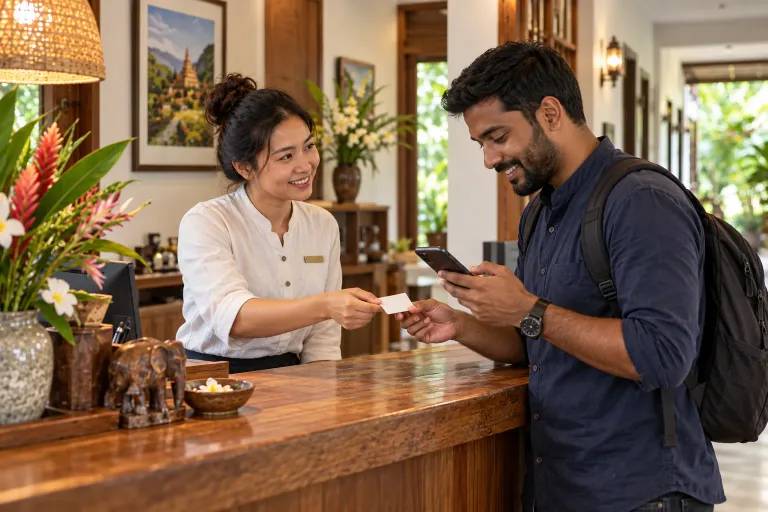
So the hotel did something cheap: at checkout, hand a card together with the room key.
The card is simple — the hotel’s own booking channels: the website, a special offer (e.g. a room-price discount on the next direct booking), and one line: “book directly from us and there’s no platform commission — we pass that saving back to you.”
This step looks plain, but it turns the OTA guest’s last face-to-face moment into the starting point of an owned channel. Next time the guest remembers, not just “I booked this place on Agoda,” but “this place said booking directly is cheaper.”
What this phase was deliberately not
- Not a full hotel system. No PMS, no availability board, no channel calendar, no front-desk reports;
- Not a channel manager. Self-booking and Agoda are two independent channel routes — no automatic availability sync, no reconciliation — the direct channel stands firm first, then talk about integration;
- Not a loyalty platform. The return card works on a simple promise — “direct booking is cheaper” — not points, tiers, or a login backend;
- Not every room type online. Complex rooms, long stays, and monthly bookings stay on human confirmation.
How phase two is judged a success
After phase two ran a while, the hotel looked at three things:
- Did online booking catch the orders it was meant to? Did direct orders rise in the late-night and busy hours?
- Did return actually happen? When guests booked again, did some call or use the website holding the card, instead of opening Agoda?
- Did the front desk’s burden rise? If online orders only created more calls, reconciliation, or re-entry, the automation failed — data is more honest than feelings.
Part 6 looks back at both phases together: how far OTA reliance fell, why each step was decided that way, and how this case held the “no large hotel systems” line.
Boundary matters: the self-booking (availability plus deposit) in this phase is the hotel’s independent system project, phase-two scope, and is not part of a standard website package; it is also not channel-integrated with Agoda or other OTAs. Online payment, PMS, and channel manager remain separate systems and do not become part of a standard website package by appearing in this case.